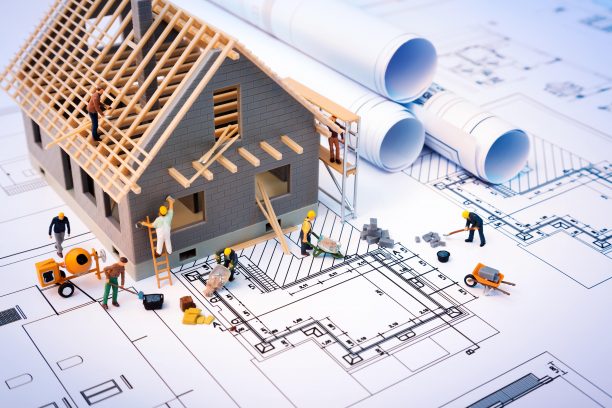
When it comes to building a house there are many stages that need to be followed to ensure your construction is built safely and securely.
The majority of houses being built today are utilizing a standardised practice. This allows consistency throughout the country in regards to building codes and requirements. This also safeguards the techniques being used to produce your houses efficiently and cost effective.
These are the stages of building a house:
- Grading and site preparation
- Foundation
- Framing
- Roofing
- Installation of windows and doors
- Rough electrics and plumbing
- Rough HVAC
- Insulation
- Drywall
- Bathroom and kitchen counters and cabinets
- Trim
- Painting
- Finish electrical and plumbing
- Carpet and flooring
- Finish HVAC
- Hookup to water main and sewer systems
- Punch list
Many of these stages require subcontractors who specialize in their area of expertise. They all work under a contractor/supervisor, who coordinates and oversees everything. The superviser is liable for ensuring the house is completed on time, on budget and to correct specifications.
Now, below is a walk through of each stage so you can understand whats involved and the steps and materials required in the construction of a house. (Standard 3 bedroom house as example)
Grading And Site Preparation
This is the first crew on site. This stage involves clearing the land and creating a flat a surface for the foundation of your house.
Clearing the land and getting rid of any trees, rocks, debris that are on your block. This can vary in time depending on what your blocks like. If there’s a lot of thick, sturdy trees expect this stage to take longer than a site that only has a couple of flimsy trees and bushes to remove.
Grading is the leveling of the site. This is when earth is moved and filled to create a flat surface. If working with slopes, they make it as even as possible for construction to be easier. Grading is also used to manipulate the flow of water around your property. In the event of rain, even flooding, this prevents the water from running directly to your house, but hopefully around it or even to your garden beds.
Foundation
When it comes to foundations, the slab is one of the easiest and probably most common. A flat concrete pad is poured out on the level ground, this requires little preparation and minimal framework for the concrete. It’s a particularly favorable choice in warmer climates, while it can have issues in cooler climates due to ground freezes – they can potentially cause the slab of concrete to shift, in the worst circumstances.
To ensure your concrete slab is stable, steel reinforcing rods and wire mesh are used to prevent any movement and provide added strength. Some basic connections have to be constructed before the slab is actually poured.
This include sewer pipes, electrical conduit etc.
Another alternative that is used frequently is housing that is built on stilts. This is used particularly in areas where flooding can occur. Stilt houses allow extra height so potential water can flow underneath the house, hopefully without causing too much damage.
Framing
In this stage the basic molding of the house is put up. This is when you start to really see your house taking shape. There are two main materials used when constructing a house, bricks or lumber.
Using lumber to build your house is less expensive and can be faster. The walls are constructed on the floor and then lifted upright. The exterior walls are constructed first and then the interior walls follow. Everything is secured into place.
Using bricks to build your house is more expensive and can take longer. Your house is constructed brick by brick ensuring everything is level, in the correct place and the measurements match up.
Roofing
Now is the stage when the top of your house goes up. Trusses are often used for roof framing, they are pre-fabricated triangular structures that are utilised to support the roof.
These are the main advantages from using trusses for roofing.
- They are incredibly strong and rather inexpensive, which makes them great for roofing.
- Trusses allow you to create any shape that you could want for your roof and ceiling. This allows you to create features such as cathedral ceilings for a unique touch.
- The trusses have the ability to span a large area. This means that all the weight is bared onto the exterior walls, so the interior walls are non load-bearing. This is especially useful if you want to change the interior design in the future as you can do so without compromising the structural integrity of the house.
- They go up incredibly quickly as they are pre-made and just have to be put in place.
The alternative to trusses are using 2×8’s and 2×10’s to build up your roofs frame. Which can be more expensive and time consuming.
Once the framing for your roof is up a material will be laid on to the framing to provide a solid and water proof base. Then depending on the type of roof you have chosen, the material be be installed can take a little longer than others.
Windows And Doors
Now things are beginning to look enclosed, the last thing that needs to finish it off before you can lock up the house is the windows and doors. Depending on the walls and doors that you have organised to install and the number of them it can take up more time. Once this stage is complete and everything has been waterproofed and tested, your home is now able to be locked up. This is when most owners begin getting excited about their house as they can see it.
This is also known as the ‘lock up’ stage as you can now secure your house preventing any unwanted visitors. Building sites are an interest to thieves unfortunately, be sure nothing gets left on site before the lock up stage is complete.
Rough Plumbing And Electrics
When it comes to plumbing and electrics, if your have a concrete slab most of the rough stuff has already been completed.
For plumbing this includes the accesses to clean running water, and piping systems to dispose of waste and used water. There are specified codes and requirements that each plumber has to ensure they follow for safety and hygiene. Everything from diameters, materials, supports, angles, distances etc are all controlled.
When it comes to electrics, this is establishing electrical systems for your power points, lights and appliances. All the boxes for electrical outlets, lights and switches are installed first. The wires are run from the fuse box to each box and between boxes. This is done following guidelines to ensure that your electrical system won’t be over powered and that everything is going to last for many years.
Rough HVAC
HVAC is an abbreviation of heating, ventilating and air conditioning systems. At this stage the systems are roughed out, where they will run to, where the control panels are going to be etc. This stage include the running of materials that can’t be installed later on. There are a variety of systems for heating and cooling, depending on your environment and what you want within your home with depict what systems you choose.
Insulation
Insulation is installed to lower costs of heating and cooling. This is due to insulation limiting the transfer of heat through surfaces and it also prevents heat getting in when you are trying to keep your house cool.
The process is started by the installation of foam channels in the eaves. The channels allows the flow of air throughout the house and roof. There is often a thin plastic barrier over the insulation. This plastic barrier is known as a vapour barrier – it keeps the moisture that develops from constant heating and cooling from damaging the house, preventing mold and any potential issues occurring.
Drywall
This is when the plasterboard goes up and creates your interior walls. It is extremely solid and can be rather heavy. This is usually done in a day or two. When the drywall is up and completed you can fully see your house for the walls and ceiling. The drywall is then covered by spackling compound to create a completely smooth finish for painting.
Counters And Cabinets (Kitchen and bathroom)
A subcontractor will install your kitchen and bathroom cabinets. They are often a straightforward task and can be completed quite quickly for those who are use to installing them. They are simply aligned to the wall and screwed into place, and the countertops are screwed on to the top of the cabinets.
Trim
Once the cabinets and counter tops have been installed, the interior doors are installed. The molding around the doors, windows and baseboards goes in as well. This is the trim for finishing touches. This also includes skirting boards being fitted and installed.
Painting
Once the molding and trims are on, it is time for painting or wallpapering the interior. This can take a little bit of time and it can require some time for the strong scent of paint to dissipate. Prior to painting the colour the wall needs to be primed and then usually 2 coats of colour paint is applied. This can take a little bit of time to be completed to a polished finish.
Finish Electrical And Plumbing
This is when the electrician returns to installs the light fixtures, all outlets, switches and cover plates for that finished look.
The plumber will return once the cabinets and counter tops are in to install sinks, toilets and faucets. A water heater will also be installed if it wasn’t installed during the rough plumbing. This is done after the cabinets and counter tops are installed to ensure that it is a secure fit.
Carpet And Flooring
Once the painting is done, it is time for the flooring to go in. This can be carpet, tiles, vinyl etc – whatever you have chosen for your flooring. You should always be sure to get your painting done and fully completed before installing the flooring as paint can get everywhere and ruin your new flooring. Depending on what floor covering you have chosen it may take a couple of days for it to be completed. This relies on the quality of the concrete and the type of flooring you have it may need to be smoothed over or leveled out.
Finish HVAC
At this stage the final touches are installed for your HVAC systems. This includes everything from control panels, the machines required for your system to be functional etc. This is usually a simple job and just putting the final touches in place for a completed look.
Hook Up To Water Mains And Sewer Systems
You can either have a private well and septic system or you can hook it up to municipal water and sewer lines. A subcontractor will be hired for a private well to be drilled and septic tank to be installed. Otherwise, a subcontractor or municipality will be hired to extend the line to the house. The plumber will then hook up the water and sewer lines.
Punch List
This is a list that the builder goes through once the house is done. The builder inspects it and notes any issues or problems that they can spot and writes it down on the punch list. With any issues that are spotted the builder will get the subcontractors back in to fix all of them. This ensures you get what you want to the standard that is acceptable.
Once all of these stages have been completed, you can move in! There are many rules and building codes that everyone hired to construct your house must follow. These stages ensure the integrity of your house.
Expenses Of The Construction
When it comes to the expenses of the stages it is helpful to know how much of the total contract is required. This can also assist in building loans that you may have taken out to complete your home.
Base
This is everything from the site preparations to pouring the foundation. This is usually 10% of the total contract.
Framing
This is the framing of the house as explained before. On average this expense is 15% of the total contract.
Lock up
This is everything from windows, doors, electrics, plumbing etc. The lock up stages of the contract cost 35% of the total contract expenses.
Fixing
This is where anything is water proofed, insulation, drywall, cabinetry, shelving etc. Often this is around 20% of the contract to cover these expenses. Be sure to discuss with your builder what exactly is included and what finishes they are too – you may want something different than what they have quoted on the building contract.
Completion
This is the final stage of your construction which is the punch list of any repairs or alterations that are required to be made. This is the last 15% of the contract for your house construction expenses.
Related questions
How long does it take to build a house?
The time it takes to build a house is dependent on many variables. On average a standard house can be built within 4-6 months. If you are building a two storey home it will take an average of 12-24 months to fully complete, especially if it is a custom build. While a production house can take as little as 4 weeks.
Read our full guide here.
How much does it cost to build a house?
Depending on where you live the price of your build can vary, taking into consideration design and many other variables. The best way to get a rough idea for the expenses of your build is to price by a square meter. This allows you a rough estimate for the total expenses. On average it can cost £500-£3,000+ per square meter.